Runtime Monitoring of AI-enabled Systems
How can symbolic reasoning and formal logic provide runtime insight into model behavior, performance, and anomalies under real-world variability?
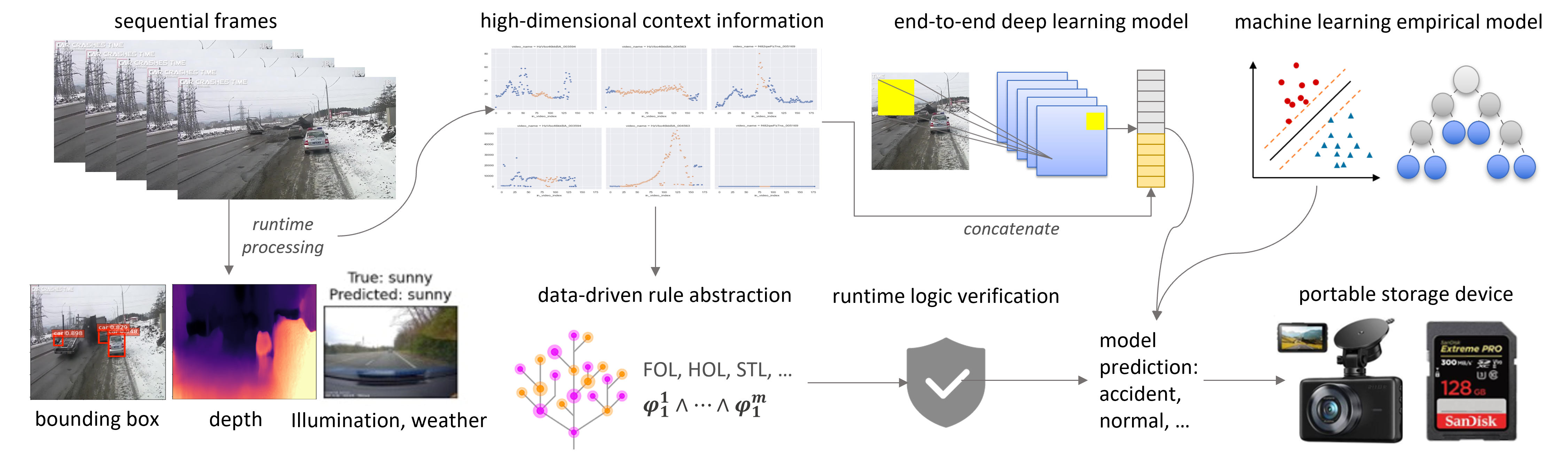
To provide insight into specification satisfaction under uncertainty, we developed a logic-based monitoring framework for traffic safety that analyzes dashboard camera streams using temporal specifications. This framework detects dangerous driving behaviors and accidents beyond traditional accuracy metrics.
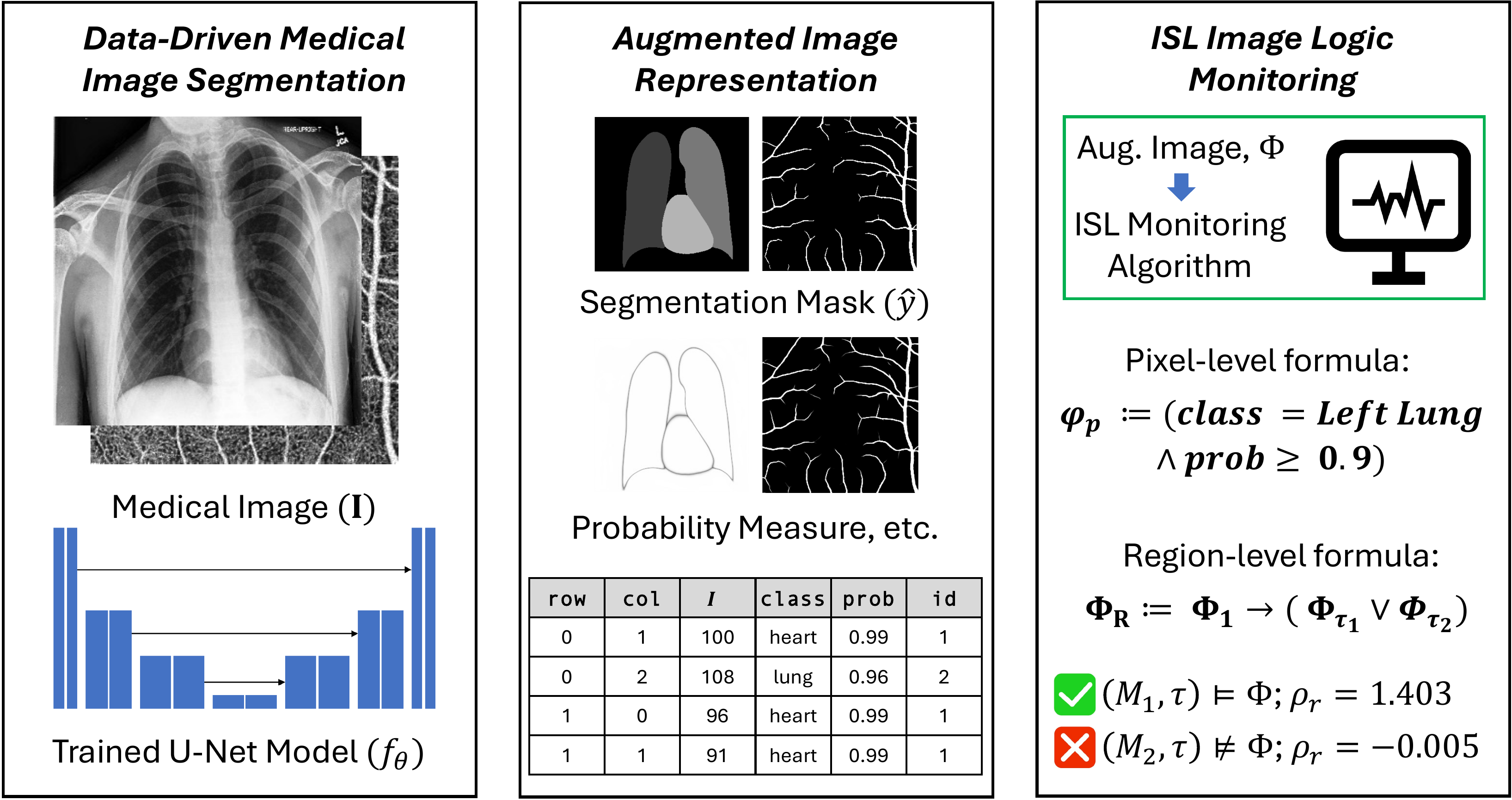
In smart health applications, we introduced a formal specification logic for medical image segmentation to qualitatively and quantitatively assess model outputs against anatomical and topological constraints. This approach enables structured reasoning about anatomical consistency rather than relying solely on pixel-level accuracy.
Building upon these contributions, my ongoing research aims to extend formal specifications into richer temporal domains. Specifically, I seek to monitor data-driven segmentation models over time, enabling reasoning about temporal consistency and structural integrity in continuous data streams. For example, the framework will be able to detect violations where a segment in one frame shifts significantly in the next frame, indicating instability or potential model failure. By incorporating temporal logic into segmentation and perception monitoring, this work advances reasoning about deep learning models in dynamic cyber-physical system environments, such as driving and smart health systems.
Related Publications